Woman Radical Kanji 女 and Why "Hate" Is Written With It
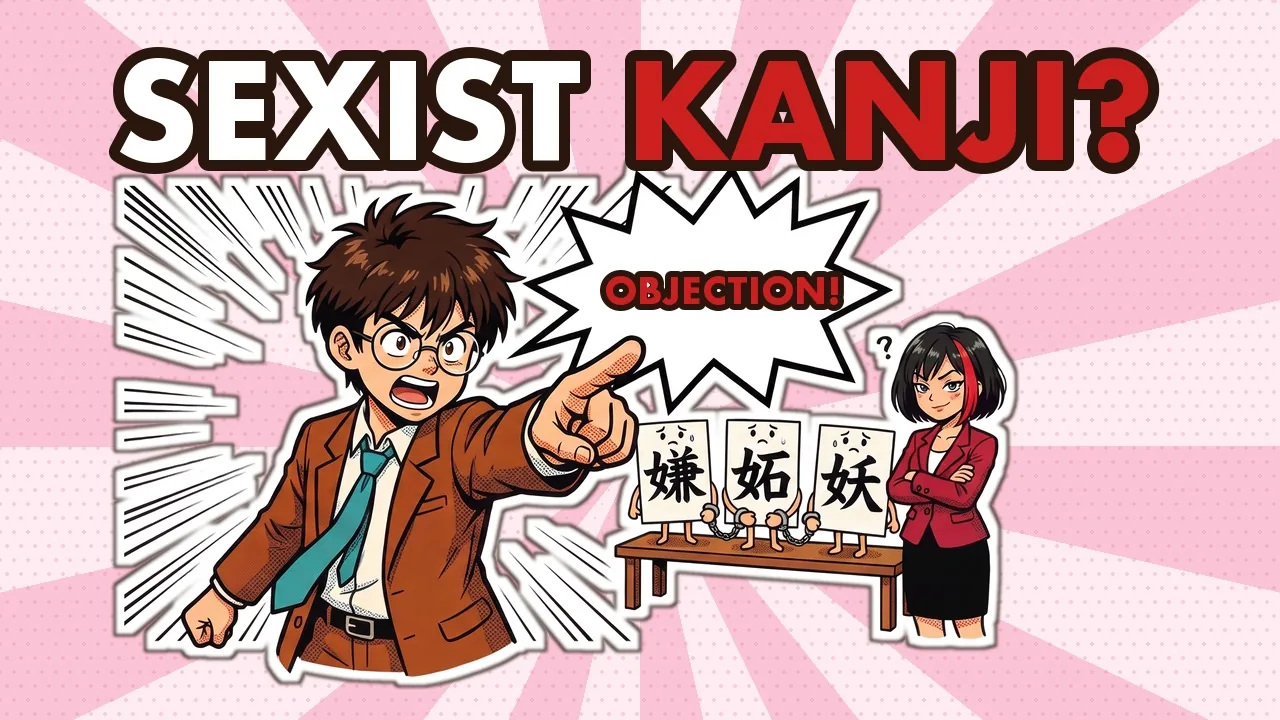
In Japanese, the word "hate" (嫌) is written with a woman inside. So are jealousy (妬) and monster (妖). The big classic Kangxi dictionary files 681 characters under the woman radical 女. It's easy to look at that list and decide the writing system hates women.
The real answer is more interesting. In about two out of three everyday kanji, one half is a label that says what kind of thing the word is, and the other half only tells you how to say it. In this episode of Rin & Tadashi the kanji go on trial: Rin prosecutes, Tadashi defends, and Mikan the cat is the judge, when he's awake.
Case 1: woman, like, and calm
On oracle bones over three thousand years ago, 女 (onna) is a person kneeling with arms folded. Tadashi points out that everyone sat like that back then, men too. When 女 sits on the left of a kanji it gets squeezed thin. That side is called onna-hen.
Woman plus child, 好, means "like" or "good". You know it from 好き (suki). Why "good"? A mother with her child? A pretty girl? Scholars still argue.
A woman under a roof, 安, means peace and calm. But in Japanese, 安い (yasui) also means cheap. That part is Japan's doing, not China's. The Japanese word yasui meant calm, easy. By the year 909, "easy" also meant easy on the wallet, and the kanji picked up "cheap" with it. In Chinese, 安 doesn't mean cheap. Verdict: not guilty.
Case 2: hate and jealousy are a filing system
Here is the trick. 嫌 is woman plus 兼. On its own, 兼 reads ken. In compound words, 嫌 also reads ken. So the right half doesn't mean "hate". It means "say ken". The meaning comes from the word itself, and the scribes filed it under "woman". On its own, 嫌 uses its Japanese reading, 嫌い (kirai).
Jealousy, 妬, works the same way: woman on the left, and the right half was the sound back in old Chinese. Around the year 100, a scholar called Xu Shen made the system official with the first dictionary sorted by labels: 540 drawers. The woman drawer got a lot of feelings nobody wanted. Tadashi's verdict: the kanji are not guilty, the filing clerks are.
Pop quiz from the episode: in 妖, which half is the sound? 夭 reads yō, and 妖 reads yō, as in 妖怪 (yōkai). So monsters aren't women either.
Case 3: the one that isn't funny
奴 is woman on the left and a hand on the right. A hand grabbing a woman. It meant a captive, a slave.
But there's a twist. In classical Chinese, 奴 was mostly the male slave. Female slaves had a different kanji. And back then 女 and 奴 sounded almost the same, so the woman was probably also the sound. Today 奴 reads やつ (yatsu) and means "guy". Koitsu, "this guy", can be written with it the old way.
Case 4: the broom lady had an army
婦 is woman plus a broom. Today it's in 主婦 (shufu), housewife. So, a woman with a broom from day one? Not quite.
On Shang dynasty oracle bones, 婦 was a title for royal and noble women, often written with just the broom. One theory says it was a sacred broom for sweeping the temple of the ancestors. The most famous holder of that title was Fu Hao, 婦好, around 1200 BC. She was the wife of King Wu Ding, a priestess, and a general who led up to 13,000 soldiers. Her tomb was found in Anyang in 1976, the only Shang royal tomb ever found untouched.
The same case gives you a superpower. 姓, surname, is woman plus 生, "to be born". You know 生 as the "sei" in 先生 (sensei). So 姓 reads sei, 性 reads sei, and 星 (star) reads sei in compound words. Three kanji you can read without studying.
Case 5: the men
男 (otoko), man, is a rice field 田 on top of 力, power. And 力 most likely started as a drawing of a plow. So a man is a field and a plow. Rin's verdict: men are farm equipment.
Japanese restroom signs often show 男 and 女, or the longer 男性 (dansei) and 女性 (josei). Some department store maps call the ladies' room 婦人 (fujin).
Rin closes the case herself: the kanji aren't sexist, some of the people who built them were. And the words keep changing. 奥さん (okusan), wife, comes from samurai wives living in the inner rooms of the house, and a lot of young people now just say 妻 (tsuma).
Japanese words from this episode
| Japanese | Reading | Meaning |
|---|---|---|
| 女 | onna | woman |
| 女性 | josei | woman (polite) |
| 好き | suki | to like |
| 安い | yasui | cheap |
| 嫌い | kirai | to dislike, hate |
| 妖怪 | yōkai | monster, spirit |
| 奴 | yatsu | guy, that dude |
| 婦人 | fujin | lady |
| 姓 | sei | surname |
| 男 | otoko | man |
| 男性 | dansei | man (polite) |
| 奥さん | okusan | wife (someone's wife) |
| 妻 | tsuma | wife |
FAQ
Why is the kanji for hate written with woman?
In 嫌, 女 works as a label and 兼 gives the sound, ken. The right half doesn't mean hate, and the scribes simply filed the word under "woman".
Are kanji with the woman radical sexist?
Some old meanings are ugly, like 奴, captive. But many "bad" ones are sound-plus-label kanji, and 婦 started as a title for royal women like Fu Hao.
What does 安 mean in Chinese and Japanese?
In both it means peace or calm. Only in Japanese does 安い (yasui) also mean cheap.