Anime Words in Japan: 4 That Get You in Trouble, 1 That's Fine
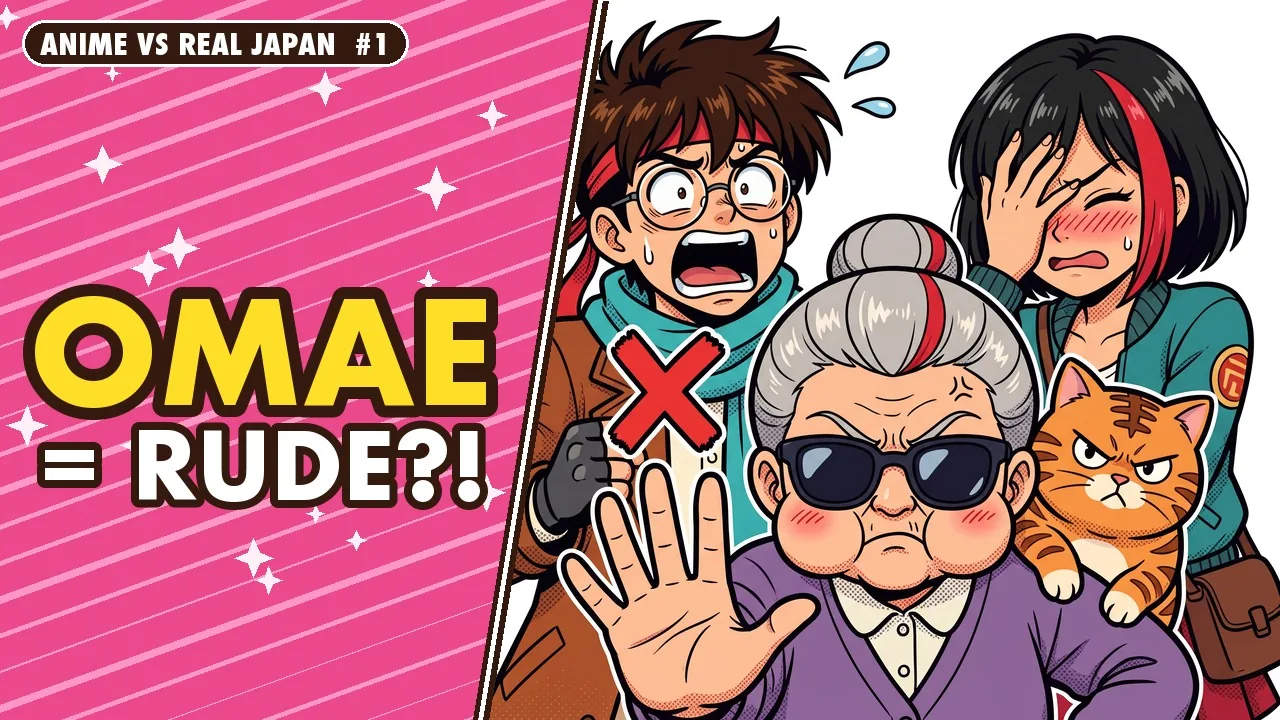
Say omae to a stranger in Japan and it sounds like "Hey, you. Wanna fight?" Most of the anime words fans know by heart can get you in trouble in real life. Of the five in this episode, four are risky. Only one is exactly what anime says it is.
Tadashi has watched three thousand episodes of anime and thinks he's fluent. He has one day to fix his Japanese before dinner with Rin's grandma in Osaka, and he plans to greet her like a shōnen hero. Here is what he learns between Tokyo, Nara and Osaka.
Omae: "you", or "wanna fight?"
お前 (omae) just means "you". But it's rough. You use it with close friends or with someone younger. Never with someone older, and to a stranger it sounds hostile. Tadashi yells it at an office worker to ask for the station, and the man runs away.
The twist: about four hundred years ago omae was super polite. It was written 御前, "the honorable front", the space in front of a god or a lord, and then the lord himself. Polite words wear out. 貴様 (kisama) did the same: samurai once used it in polite letters, and now anime rivals scream it.
What to say instead? To a stranger, start with すみません (sumimasen). And when you meet someone's grandma, skip "you" completely: はじめまして。ただしです。よろしくおねがいします。 "Nice to meet you. I'm Tadashi. Please be kind to me." The kanji is 前 (mae), "front" or "before", the one in 名前 (namae, name) and 午前 (gozen, a.m.).
Senpai: the 19-year-old boss
"Notice me, senpai!" Tadashi thinks 先輩 (senpai) means "someone older". It doesn't. Your senpai is whoever joined your school, club or job before you. Age doesn't matter. In the episode, a nineteen-year-old cleaner trains a sixty-year-old apprentice. She is his senpai. He is her 後輩 (kōhai).
Senpai also stays inside your group. To station staff, you say sumimasen again. Senpai and 先生 (sensei) share the kanji 先 (sen, "ahead"), and sensei originally meant "born before you".
Baka: horse plus deer?
In Nara, a deer steals the gift, and Tadashi ends up stuck in a pillar hole at Tōdai-ji yelling 馬鹿 (baka). That hole is about the size of the Great Buddha's nostril, and they say crawling through it brings good health.
Baka is written "horse" plus "deer", and many people say it comes from a Chinese legend. The legend exists: in 207 B.C. a minister brings the young emperor a deer, calls it a horse, and punishes the officials who said "deer". But most dictionaries point somewhere else: Buddhist monks, and an old Sanskrit word for "foolish", moha. The horse and the deer came later, just for the sound.
In Kansai, baka really hurts and あほ (aho) is almost friendly. In Tokyo it's the other way around. In 1990 an Osaka man wrote to the TV show Tantei! Night Scoop: in fights he said aho and his Tokyo wife said baka. The show mapped all of Japan and won a big award in 1991.
Onii-chan: why you sound five
お兄ちゃん (onii-chan) in a cute anime voice is how little kids talk. Grown-ups say お兄さん (onii-san) to a young man and お姉さん (onee-san) to a young woman. In Japan, strangers use family words with -san. A kid may even call you おじさん (ojisan), "uncle".
Linguist Takao Suzuki wrote in 1973 that many Japanese families talk from the youngest kid's point of view. A mom calls her older son "onii-chan" and her husband お父さん (otōsan), "dad". The kanji here is 兄 (ani, "big brother"): a mouth on top of legs.
Itadakimasu: the one anime got right
Naruto says いただきます (itadakimasu) before his ramen, and people in Japan really do say it. Anime got this one right. But it doesn't literally mean "let's eat". It means "I humbly receive", and you say it even when you eat alone. People say it thanks the cook, the farmer and the food.
The verb いただく (itadaku) once meant "to put on top of your head". When someone important gave you something, you lifted it above your head. That's why its kanji, 頂, is "the top of the head", as in 頂上 (chōjō), "summit". Just don't lift your okonomiyaki that high.
Japanese words from this episode
| Japanese | Reading | Meaning |
|---|---|---|
| お前 | omae | you (rough; close friends or younger people only) |
| すみません | sumimasen | excuse me |
| はじめまして | hajimemashite | nice to meet you |
| 先輩 | senpai | someone who joined before you |
| 後輩 | kōhai | someone who joined after you |
| 先生 | sensei | teacher (originally "born before") |
| 馬鹿 | baka | idiot |
| あほ | aho | dummy (softer in Osaka) |
| 馬 | uma | horse |
| 鹿 | shika | deer |
| お兄さん | onii-san | young man (to a stranger) |
| お姉さん | onee-san | young woman (to a stranger) |
| おじさん | ojisan | uncle, older man |
| いただきます | itadakimasu | I humbly receive (before eating) |
| おつかれさまでした | otsukaresama deshita | thanks for your hard work |
FAQ
Is it rude to say omae in Japan?
To a stranger or to someone older, yes. It sounds like you're picking a fight. Between close friends, or from an older person to a younger one, it can even sound warm.
What does senpai really mean?
Senpai is whoever joined your school, club or job before you, even if they are younger. The person who joined after you is your kōhai.
Does baka really come from "horse" and "deer"?
Probably not. Most dictionaries trace baka to a Sanskrit word for "foolish" used by Buddhist monks, and the kanji for horse and deer were picked later for their sound.