King Kanji 王 Is Not a Tiger Mark, It's an Axe
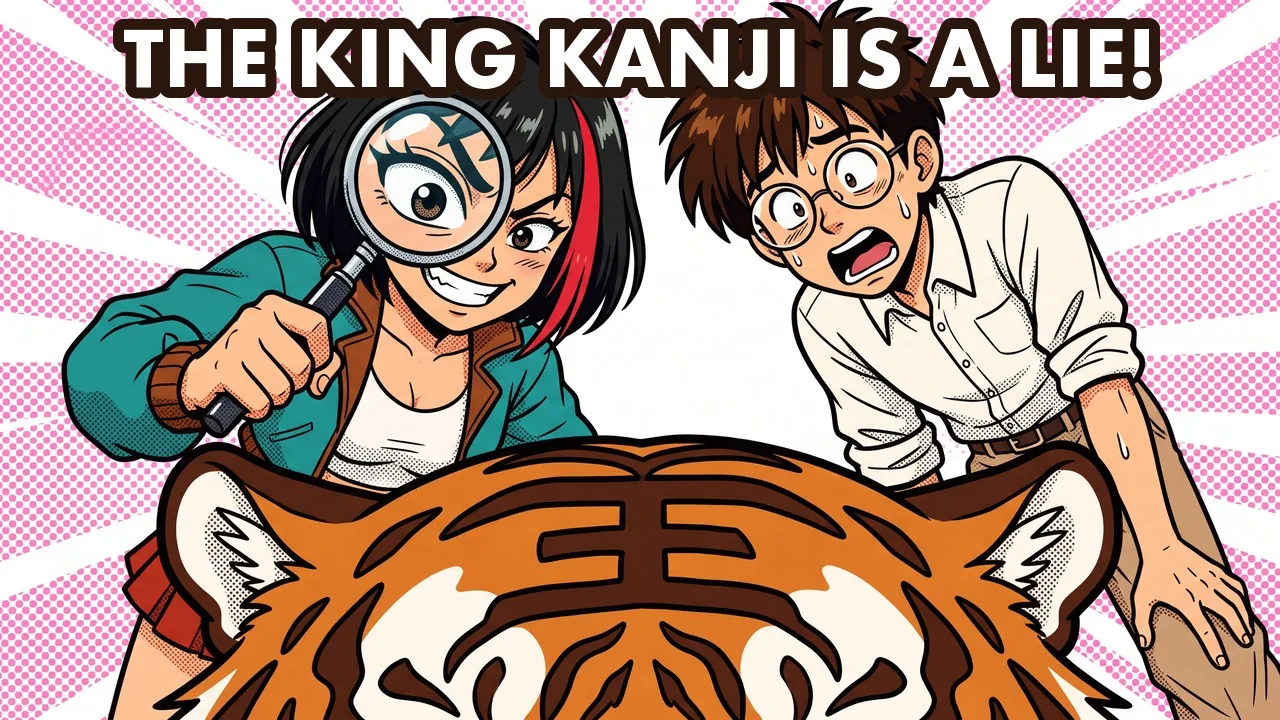
The king kanji 王 (ō) really does look like the stripes on a tiger's forehead: three lines across and one straight down the middle. Kids in Japan grow up hearing that the tiger is king because it says so, on its face. It's a beautiful story. It's also a lie.
The oldest Chinese writing we have tells a different tale. On those bones, 王 is not a tiger at all. It's an axe. In the first episode of Rin & Tadashi, Rin tells the legend, Tadashi ruins it, and you learn twelve Japanese words that all grow out of that one character.
The legend: how the tiger got its mark
Long ago, up in the heavens, the Jade Emperor held a tournament. Every animal showed up and the tiger won three times. (Tadashi points out that the sources don't agree on the exact number. Rin tells him it's story time.)
The Emperor was impressed, so he drew three lines on the tiger's forehead, one for each victory. Then the tiger went back down to Earth and beat a huge monster that was eating villages. So the Emperor added one more line, straight down through the three. Three across, one down: 王, king.
The mark is real, too. Look at a tiger. Then look at your cat. In China, on the Dragon Boat Festival, parents still paint 王 on their kids' foreheads for protection.
The real origin: king was an axe
Around 1200 BC in China, priests carved questions into turtle shells and ox bones, heated them until they cracked, and read the cracks as answers. These oracle bones hold the oldest Chinese writing we have. And there, the character for king is a big ceremonial axe, handle on top, blade at the bottom.
In early China the axe was the tool of execution. Whoever held the axe decided who kept their head. That was the whole job description of a king. The tiger story came later, and it survived because, as Tadashi admits, everyone likes the tiger better.
About a thousand years later, Qin Shi Huang unified China and standardized the writing: one shape for every character, the axe included. To make sure nobody argued, he burned the books and, reportedly, buried scholars alive.
Tiger, queen and jewel: the king's family
The tiger itself is 虎 (tora), eight strokes. The top is the tiger-stripes radical and the bottom is two little legs. A striped head on legs. You may know the word from "Tora! Tora! Tora!", the code used at Pearl Harbor.
Add 様 (sama), the polite title above "san", and you get 王様 (ōsama), "your majesty". Put 女 (onna), woman, in front of king and you get 女王 (joō), queen. Add one dot to king and it becomes 玉 (tama), a jewel or ball. On the oracle bones "king" and "jade" looked almost the same, so somebody added the dot to stop the confusion. Tama is also a classic Japanese cat name.
Country, emperor, master
Put a wall around the jewel and you get 国 (kuni), country. The older form had a spear inside the walls instead. Japan simplified it after the war, in 1946, and swapped the spear for a jewel.
The Emperor of Japan is 天皇 (tennō): heaven, plus a "shining king", which is 白 (white) on top of 王. Japan has the only monarch on Earth still called emperor. The previous emperor even published scientific papers on goby fish.
Then there's 主人 (shujin), master, which also means "my husband". The first kanji is a flame on a lamp stand: the one who keeps the fire is master of the house. Rin is not impressed. Some women now say 夫 (otto), which just means husband.
Crazy dogs and fired tigers
狂う (kuruu), to go crazy, is a dog radical next to king. Everyone says it's "a dog that thinks it's king". Tadashi says that's wrong: the king part is only there for the sound. Rin says: have you met a chihuahua?
百獣の王 (hyakujū no ō) means "king of a hundred beasts". In Japan that title goes to the lion, even though Japan has never had a single lion. The tiger, who was there first, lost the job to an animal nobody had seen.
Two more: 王手 (ōte), king plus hand, is "check" in shogi, and people use it at work for being one move from winning. And 虎の子 (tora no ko), tiger's cub, is the treasure you'd protect no matter what, like your savings.
Japanese words from this episode
| Japanese | Reading | Meaning |
|---|---|---|
| 王 | ō | king |
| 虎 | tora | tiger |
| 王様 | ōsama | your majesty |
| 女王 | joō | queen |
| 玉 | tama | jewel, ball |
| 国 | kuni | country |
| 天皇 | tennō | the Emperor of Japan |
| 主人 | shujin | master; my husband |
| 狂う | kuruu | to go crazy |
| 百獣の王 | hyakujū no ō | king of the beasts |
| 王手 | ōte | check (in shogi) |
| 虎の子 | tora no ko | your treasure (lit. tiger's cub) |
FAQ
Do tigers really have the kanji for king on their forehead?
The stripes on a tiger's forehead do look like 王. But the character wasn't based on the tiger. The legend of the Jade Emperor drawing it came later.
What did the king kanji originally mean?
On oracle bones from around 1200 BC, 王 was a picture of a ceremonial axe. The king was the person holding the axe.
What is the difference between 王 and 玉?
One dot. 王 (ō) is king. 玉 (tama), with a dot at the bottom right, is a jewel or ball. The dot was added because the two looked almost the same.