Japanese Ghosts and Yokai Explained by Their Names
Most Japanese ghosts tell you their plan in their name. Read the kanji and you know what the monster is, where it lives and what it's going to do to you. Sometimes the name is the whole movie.
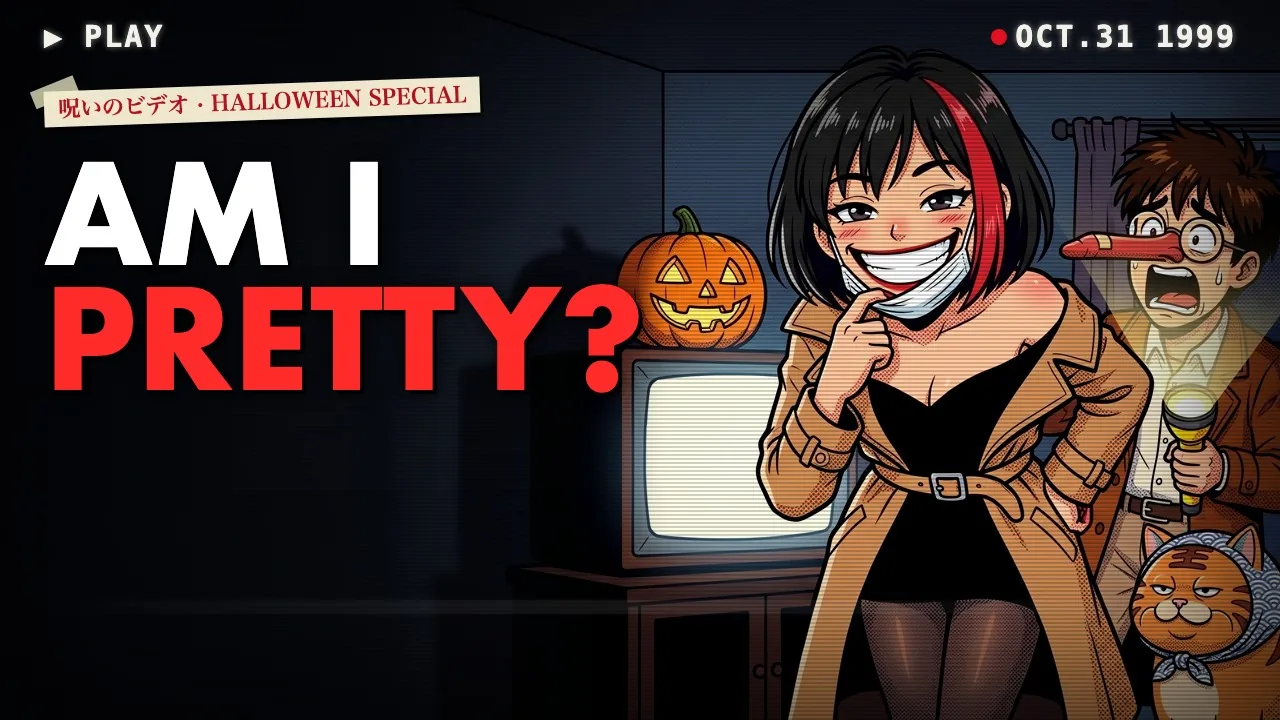
In this Halloween episode Tadashi wants to watch a Japanese horror film with no subtitles. He can't read Japanese. So Rin, dressed as the slit-mouthed woman, makes him a deal: five ghosts, and at the end he reads the movie poster himself. Here is every ghost from the video, and the kanji that gives each one away.
Kuchisake-onna: the slit-mouthed woman
Her name is three pieces. 口 (kuchi) means "mouth". It's a square, an open mouth, and that's the whole kanji. 裂け (sake) means "slit". 女 (onna) means "woman". Slit-mouth woman. You already know the story.
She wears a mask and asks you 「わたし、きれい?」 (watashi, kirei?), "Am I pretty?" Say yes and she pulls the mask down: 「これでも?」 (kore demo?), "Even like this?" Say yes, she cuts you. Say no, she cuts you. The answer that saves you is 普通 (futsū), "normal". She stops to think about it, and you run. Tadashi spends a good part of the episode trying to say "normal" to a woman with scissors without it sounding like an insult.
The part nobody tells you: in 1979 Japan believed she was real. The rumor started in Gifu, after an old lady fainted next to an outdoor toilet and said she had seen her. By the summer there were police patrols and kids walking home from school in groups. On June 21 police in Himeji arrested a woman dressed as her, carrying a kitchen knife. Flu masks were everywhere back then, so any woman in a mask could be her. The panic ended in August, when school let out.
Tengu: the "sky dog" with no sky and no dog
天狗 (tengu) is 天, "sky", plus 狗, "dog". A sky dog. The tengu everyone knows today is a mountain creature with wings, a red face and a long nose. No dog anywhere.
The name is a leftover. In ancient China a tengu was a meteor, a fireball with a bang, and people said it sounded like a dog barking in the sky. In the year 637 a shooting star crossed Japan with a sound like thunder, and a monk said: "That's a tengu." The name stuck. Then the meteors stopped, the name had no owner, and it went to a monster in the mountains. Wings came later, and then someone added the nose. One last rule: the longer the nose, the more powerful the tengu. Tadashi's cardboard nose falls off right on that line.
Kappa: the river child you beat with good manners
河童 (kappa) is 河, "river", plus 童, "child". It lives in the river, looks like a child, and carries a dish of water on its head. The kanji for dish, 皿 (sara), actually looks like a dish seen from the side.
If the water spills, the kappa loses all its strength. You don't fight it. You bow, deeply. It's polite, so it bows back, the water spills, and you leave. The kappa also loves cucumbers. That's why the cucumber sushi roll is called かっぱ巻き (kappa-maki). And if you don't bow? Rin only says it reaches somewhere you don't want it to reach. Just bow.
Kasa-obake and bakeneko: things at 100, cats at 13
In Japanese folklore, objects that reach a hundred years, 百年 (hyakunen), come alive as monsters. So people threw old things away before they got there. The famous one is the kasa-obake, the umbrella ghost: an old umbrella with one eye and one leg that hops around and licks you with a very long tongue. It's not dangerous. It's disgusting. Its kanji 傘, "umbrella", really is a drawing of an umbrella.
Cats get there faster. 化け猫 (bakeneko) is 化け, "changed", plus 猫, "cat". A cat that lives past twelve or thirteen changes. It talks, licks the oil out of lamps, puts a towel on its head and dances. For centuries people cut kittens' tails so it wouldn't happen. In the episode, Mikan the cat has worn a towel on his head since the first second. He's thirteen.
Yuki-onna, and yokai vs yurei
The poster at the end says 雪女. Tadashi already knows 女, "woman". The other kanji, 雪 "snow", has 雨 "rain" sitting on top. Rain woman, cold rain, snow: snow woman. That's yuki-onna, the woman in white who freezes people with her breath in blizzards. He read half and guessed half, which is how everyone starts.
Two words to keep them apart. A 妖怪 (yōkai) is a creature. It lives in a place and comes out at dusk. A 幽霊 (yūrei) is the ghost of a dead person. It doesn't live anywhere. It follows you.
And why do Japanese ghosts come out in August, not October? Because of お盆 (Obon), when for three days the dead come home and families welcome them. Horror plays in Japan were summer plays, a chill for the hot season. Halloween as a big event arrived in 1997, with Tokyo Disneyland.
Japanese words from this episode
| Japanese | Reading | Meaning |
|---|---|---|
| 口裂け女 | kuchisake-onna | slit-mouthed woman |
| 口 | kuchi | mouth |
| 女 | onna | woman |
| わたし、きれい? | watashi, kirei? | Am I pretty? |
| これでも? | kore demo? | Even like this? |
| 普通 | futsū | normal |
| 天狗 | tengu | "sky dog", a winged mountain creature |
| 河童 | kappa | "river child", a river creature |
| 皿 | sara | dish, plate |
| かっぱ巻き | kappa-maki | cucumber sushi roll |
| 傘 | kasa | umbrella |
| 百年 | hyakunen | a hundred years |
| 化け猫 | bakeneko | "changed cat", a monster cat |
| 雪女 | yuki-onna | snow woman |
| 妖怪 | yōkai | supernatural creature |
| 幽霊 | yūrei | ghost of a dead person |
| お盆 | Obon | August festival when the dead come home |
FAQ
What is the difference between yokai and yurei?
A yōkai is a supernatural creature tied to a place, like the kappa in its river. A yūrei is the ghost of a dead person, and it follows people instead of staying put.
What do you say to Kuchisake-onna?
In the legend, "yes" and "no" both get you cut. The safe answer is 普通 (futsū), "normal". She stops to think, and you run.
Why is the cucumber roll called kappa-maki?
Because the kappa, the river creature of Japanese folklore, loves cucumbers. The sushi roll is named after it.