Sushi Meaning Is Not Raw Fish, Plus 4 Words You Already Know
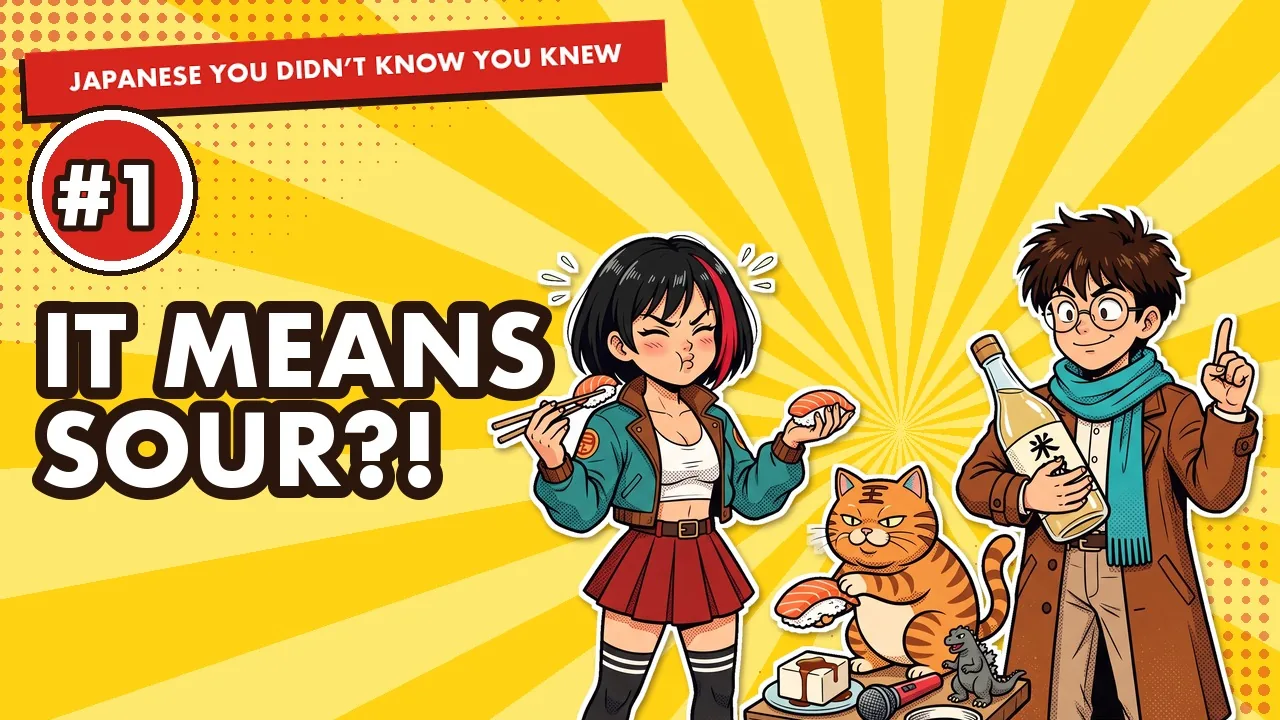
Sushi doesn't mean raw fish. It means sour, as in the vinegar rice. The fish is just a guest. And the kanji you see on every sushi shop, 寿司, don't mean "sour" either: they were picked for their sound, like a costume.
You already speak five Japanese words: karaoke, karate, sushi, tofu and Godzilla. In this episode of Rin & Tadashi, a night out in Tokyo, they show you what each one really means, the story behind it, and the eight kanji hiding inside.
Karaoke: the empty orchestra
Karaoke is only half Japanese. "Kara" (空) means empty. "Oke" is short for ōkesutora, the Japanese way of saying orchestra. Empty orchestra: the band isn't there, it's just you and the mic. Japanese does this a lot. Pasokon is a personal computer, and konbini is a convenience store.
The machine came from Kobe in 1971. A keyboard player called Daisuke Inoue played in bars for salarymen who wanted to sing. One of them had a business trip and asked for recorded backing tracks, so Inoue built a box with a tape deck, a coin slot and a mic. He never patented it. In 2004 he won an Ig Nobel Peace Prize for "providing an entirely new way for people to learn to tolerate each other."
The same kanji 空 also reads sora, sky. The sky is the biggest empty thing there is. You'll also see it in 空港 (kūkō), airport.
Karate: the hand that used to be Chinese
Karate means "empty hand". That part everyone knows. The part nobody knows: it was born in Okinawa, back when it was its own kingdom, Ryukyu. Ryukyu traded with China, and the fighting style came in with the trade.
For centuries "kara" was written with the kanji for Tang, as in Tang China. "China hand". In 1936, at a meeting of masters in Naha, they swapped the kanji. Same sound, new meaning: China hand became empty hand. Japan was heading into war with China. Rin calls it a good scam.
The second kanji is 手 (te), hand: four strokes, a hand with its fingers spread. It's in two words you'll use all the time, 上手 (jōzu), skilled, and 下手 (heta), bad at something.
Sushi: sour rice and a Norwegian salmon
Sushi started as nare-zushi, which reached Japan in the eighth century. People packed fish inside rice and let it ferment for months. Then they threw the rice away and ate the fish. The rice was the packaging.
Around the 1820s in Edo, a cook called Hanaya Yohei pressed fresh fish onto vinegar rice and sold it from a street stall. Nigiri was born. Sushi was the hot dog of Edo, eaten standing up, with your hands.
The kanji are ateji, chosen for sound, not meaning. 寿 (kotobuki) means long life and shows up on wedding envelopes. 司 (shi) means to administer, an office. So sushi is written "the Office of Longevity".
One more surprise: salmon nigiri is Norwegian. Japan didn't eat salmon raw. So in 1985 Norway started "Project Japan", and it took about ten years to win Japan over.
Tofu: rotten beans
Read the menu and 豆腐 (tōfu) says "bean" plus "rotten". The bean, 豆 (mame), is also in 大豆 (daizu), soybean, and 枝豆 (edamame), beans on the branch. The rotten one, 腐, is a storehouse with the radical for meat inside. Meat left in a warehouse. The verb is 腐る (kusaru), to rot.
In Chinese the word just meant "curd". Tofu is about two thousand years old, and Buddhist monks brought it to Japan.
Godzilla: a gorilla-whale
Godzilla is not "God" plus "lizard". In Japanese it's ゴジラ (Gojira): gorira, gorilla, plus kujira, whale. The film came out in 1954 from Toho, directed by Ishirō Honda. A famous story says the name came from a big Toho employee nicknamed "Gujira". Toho treats it as a legend. In 2024, Godzilla Minus One won the Oscar for visual effects on a budget of about fifteen million dollars.
Whale, 鯨, is fish 魚 (sakana) plus capital 京 (kyō). Rin calls it "the Tokyo of fish". It's a memory trick, but the capital is real: 京都 (Kyōto) is "capital city" and 東京 (Tōkyō) is "east capital".
They end with サヨナラ (sayōnara). Most Japanese people don't actually use it, because it can sound like goodbye forever. They say またね (mata ne), see you.
Japanese words from this episode
| Japanese | Reading | Meaning |
|---|---|---|
| カラオケ | karaoke | empty orchestra |
| 空 | kara / sora | empty / sky |
| 空港 | kūkō | airport |
| 空手 | karate | empty hand |
| 手 | te | hand |
| 上手 | jōzu | skilled |
| 下手 | heta | bad at something |
| 寿司 | sushi | sushi (written "longevity" + "office") |
| 寿 | kotobuki | long life |
| 豆腐 | tōfu | tofu (lit. rotten beans) |
| 豆 | mame | bean |
| 腐る | kusaru | to rot |
| 魚 | sakana | fish |
| 京 | kyō | capital |
| ゴジラ | Gojira | Godzilla (gorilla + whale) |
| またね | mata ne | see you |
FAQ
What does sushi literally mean?
It comes from a word for sour, because of the vinegar rice. The kanji 寿司 were chosen for their sound and read as "longevity" and "office".
Why is karate called "empty hand"?
It used to be written "Tang hand", meaning Chinese hand. In 1936 masters in Naha changed the first kanji to 空, empty, keeping the same sound.
What does Godzilla mean in Japanese?
Gojira mixes gorira (gorilla) and kujira (whale). It has nothing to do with "God".